BCACC launched our revised awards program in 2025.
We honoured our 2025 Award Recipients at an evening event held Friday, September 19th, 2025 in Vancouver, BC.

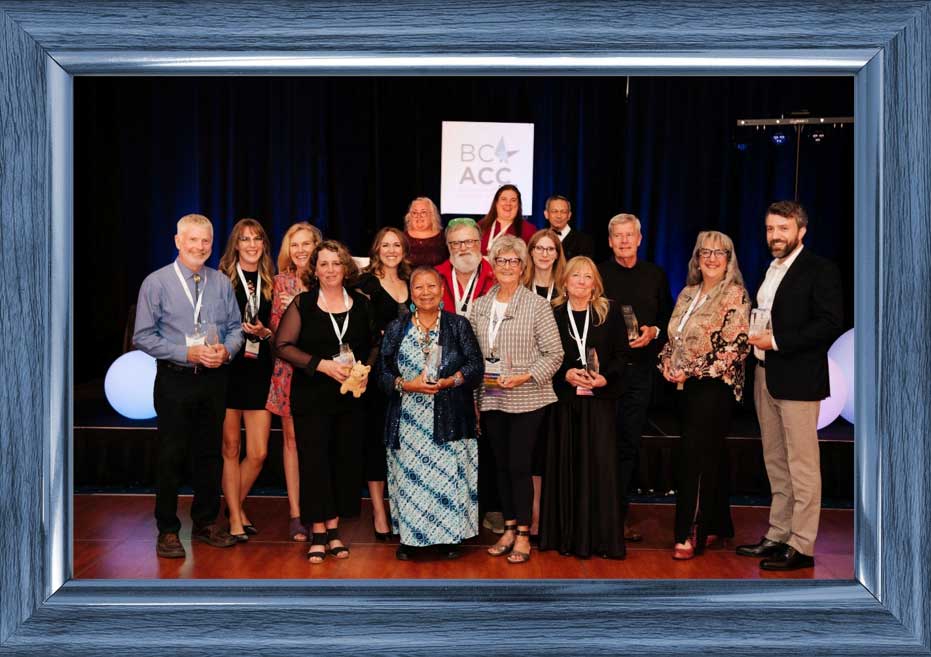
L to R: Kevin McMullen, Mary Klovance, Shelly Dean, Meg Kapil, Constance Lynn Hummel, Dr. Elder Roberta Price, David Stewart, Evangeline Willms Thiessen, Sarah Fraser (CRPO), Jane Goranson Coleman, David Hutton, Kathy Lauriente, Christopher Leckman
Back row: Marcy McCabe, Director of PR & Advocacy, Candice Alder, BCACC Board President, Michael Radano, CEO
Missing: Allan Wade, Janet White, Rhett-Lawson Mohajer
These 16 individuals were celebrated for their contributions to the Association, their communities and their outstanding work in mental health.
Distinguished Lifetime Contributions to the Profession Award
Allan Wade, PhD, RCC, CM
Allan Wade, Ph.D., RCC, a long-standing member of the BC Association of Clinical Counsellors, was appointed to the Order of Canada for his pioneering work in developing response-based practice, a specialized approach to addressing violence. A therapist, researcher, author, and academic, Allan has worked extensively with victims and perpetrators of violent crimes, as well as with First Nations, Métis, and Inuit communities across Canada. He also played a key role in developing City University’s Master of Counselling program.
Honorary Membership Award
Dr. Elder Roberta Price
Dr. Elder Roberta Price, of the Coast Salish (Snuneymuxw & Cowichan Nations), has spent more than 30 years dedicated to improving health and mental health in BC. She has shaped policy and practice through her roles as Elder in Residence with Vancouver Coastal Health’s Aboriginal Wellness Program, co-investigator in equity research at UBC, and leader in integrating Indigenous and Western health practices. Her work includes facilitating cultural safety training, guiding Indigenous healing practices in clinical settings, and advocating for healing, justice, and inclusion for Indigenous peoples across the province.
BCACC Impact Award for Mental Health Organization
College of Registered Psychotherapists of Ontario
For their collaborative and supportive partnership with BCACC—most notably by providing a letter of equivalency to the Canada Revenue Agency, ensuring RCCs were recognized as equivalent to RPs for tax purposes and removing the need for individual members to seek equivalency on their own. CRPO has also offered guidance on a potential grandparenting path into the new regulatory college and provided thoughtful review of BCACC’s standards of practice. Through their collegial sharing of knowledge, processes, and intellectual property, CRPO has helped strengthen the regulation and provision of mental health in BC.
Humanitarian Award
Dr. David Hutton
Dr. Dave Hutton holds an interdisciplinary doctorate from the University of Manitoba and has been engaged in emergency management and humanitarian work for more than 20 years. He currently serves as Director of Provincial Psychosocial Services with the Provincial Health Services Authority, supporting the mental health and resilience of communities across British Columbia impacted by emergencies. Internationally, Dave spent a decade with the United Nations Relief and Works Agency (UNRWA) in the West Bank and Gaza Strip and has participated in humanitarian missions around the world—most recently in Ukraine where he provided psychosocial care in response to the war. He is also the founder of the Grassroots Hero Foundation, which supports community volunteers in Ukraine to address the unmet needs of children, older adults, and others who might otherwise be left without assistance.
Clinical Supervisors Award
David Stewart, PhD, RCC-ACS
Dr. Evangeline Willms Thiessen, RCC-ACS
Janet White, RCC-ACS
David Stewart, Vange Willms Thiessen, and Janet White are being recognized with the Clinical Supervisors Award for their leadership, collaboration, and sustained commitment to the creation of the RCC-ACS designation and the development of a clear path for clinicians in BC to train as clinical supervisors. In 2020, they formed a task force to identify the need for qualified clinical supervisors and to explore how a designation program could support the profession. Each brought forward their own educational models for supervisor training and worked together to define the qualifications required to ensure competent, ethical supervision within the counselling community. Their efforts led to the establishment of the Clinical Supervision Committee, the creation of the Legacy Application Program, and the development of the RCC-ACS designation pathway. Their ongoing work continues to shape education, standards, and accessible routes for RCCs seeking to become approved clinical supervisors.
Distinguished Professional Contributions to Applied Research Award
Meg Kapil, PhD, RCC-ACS
Doing Well and Feeling Well: Investigating the Contributions of Two Stress Related Appraisals and Regulatory Practices on Student Success Outcomes
Dr. Meg Kapil has made a significant applied research contribution through her doctoral work integrating stress optimization and self-regulated learning into counselling practice and educational settings. As principal investigator, she developed a new theoretical framework linking stress regulation, coping self-efficacy, and learning management to student flourishing, and created practical tools such as the Academic Well-Being Scale and the Stress Stories Project, which has been piloted with students in BC schools. Her research offers counsellors concrete strategies to reframe stress, support mental health, and enhance student success, and has already led to publications, conference presentations, curriculum development, and professional training. Through the integration of theory and practice, her work is shaping new approaches to student well-being and strengthening the profession’s capacity to respond to emerging needs.
Rhett-Lawson Mohajer, PsyD, RP, RCC:
The Psychoanalysis of Music Improvisation: A Phenomenological Qualitative Study
Rhett-Lawson Mohajer has made a meaningful applied research contribution through his phenomenological study examining how musical improvisation transforms psychological experience and supports therapeutic change. Drawing on his dual background as a musician and psychotherapist, he designed and led original research exploring how playing instruments influences personality structure, emotional processing, and attachment-related meaning. His work engaged participants across multiple countries and cultural contexts, offering clinicians new insight into music as a relational and expressive pathway for healing. Through international publication and knowledge-sharing, his research is expanding the field’s understanding of how creative practice can deepen therapeutic work and inform counselling approaches.
Practitioners Award
Constance Lynn Hummel, RCC
The Business of Helping
Constance Lynn Hummel is widely recognized for her ethical leadership and meaningful contributions to the counselling profession. She has helped shape standards of practice through her work on BCACC’s Code of Ethics and is deeply engaged in mentoring, supervision, and professional education. Through initiatives like The Business of Helping and her long-standing involvement with Adler University and advisory committees, she has strengthened the profession’s capacity and advanced high standards of practice. Her influence extends through the counsellors she trains and mentors, whose work continues to elevate the quality of care across the field.
Shelly Dean, PhD, RCC
Centre for Response-Based Practice
Shelly Dean has devoted more than three decades to counselling, advocacy, and community service, offering responsive, dignity-based support to individuals, families, and organizations across British Columbia and the Yukon. Her work alongside Indigenous communities is grounded in cultural respect and systemic awareness, and she is widely sought after for her leadership in areas such as violence prevention, sexualized assault response, child welfare reporting, and social justice. With expertise spanning youth and family support, language and relational practice, organizational development, and equity-focused systemic change, she brings both compassion and clarity to complex contexts. As a counsellor, consultant, supervisor, author, and mentor, she advances ethical standards and strengthens the profession through education, collaboration, and practice-based leadership.
Mary Klovance, RCC
The Neurodiversity Family Centre
Mary Klovance exemplifies excellence in client care through her leadership of the Neurodiversity Family Centre and her affirming, trauma-informed support of neurodivergent individuals and families. She is deeply committed to ethical, client-centred practice and extends her impact beyond the therapy room through advocacy, workshops, and systemic change initiatives in schools, workplaces, and community settings. As a board member with the Institute of Neurodiversity Canada and the Accessibility Advisory Committee for School District 61, and as an educator, supervisor, and mentor, she strengthens the profession by shaping inclusive practices and supporting the next generation of counsellors. Her work continues to expand access, shift systems, and inspire more responsive approaches to care.
BCACC Volunteers Award
BCACC presented three awards to long-time volunteers this year. Together, these three individuals have contributed almost 70 years of volunteer service to the BCACC. BCACC is so grateful for the dedication and passion that these volunteers have brought to their work with BCACC.
Jane Goransen-Coleman
1999 – 2025 (continuing)
Kevin McMullen
2005 – 2025
Kathy Lauriente
2002 – 2025
BCACC Student Member Award
Christopher Leckman
For his measurable community contributions to the profession in the world of recovery and recognition from his Clinical Supervisors which have led to his appointment as a student leader.
Joan Campbell Bursary Winner
Created in 2021, the Joan Campbell Award honours the impact of BCACC Past President Joan Campbell, and her immense contributions to the Association and the psychotherapy profession as a whole. The Award is given annually in the amount of $1,000 and is funded from annual corporate and individual donations.
Covering BCACC application and membership fees, criminal record check, and insurance for the first year of membership, the Award facilitates enhanced access to the psychotherapy profession from underserved communities and supports eligible candidates experiencing financial hardship who would otherwise not be able to join the profession.
In 2025, the bursary was awarded to: Justin Brass