CLINICAL EXCELLENCE & PROFESSIONAL STANDARDS
Our mandate
The BCACC continued to advance clinical excellence across the profession by setting clear expectations for practice, supporting ongoing professional development, and equipping Registered Clinical Counsellors (RCCs) to deliver safe, ethical, and high-quality care.

Professional Practice & Accountability
As membership grows, BCACC continues to address concerns related to practice through a structured process focused on:
early resolution where appropriate
guidance and education
proportionate and fair outcomes
supporting improved practice
Key Observations
Concerns remain low relative to overall membership (≤1%), consistent with or below comparable health professions in BC
Almost all matters are resolved through consent agreements, supporting timely resolution and learning
Only one case in BCACC’s history has proceeded to formal discipline (2019)
This continues to reflect the high level of professionalism and ethical commitment demonstrated by RCCs.
Common Areas of Focus
The most frequent areas requiring additional guidance continues to be:
BCACC responded by strengthening standards, expanding training, and supporting practitioners in navigating complex clinical situations.
Advancing Clinical Excellence
BCACC continues to play a leadership role in advancing clinical excellence and supporting members in navigating emerging areas of practice, while preparing for regulation under the Health Professions and Occupations Act (HPOA).
BCACC strengthened professional practice through:
New practice guidance, including:
- guidelines on the use of artificial intelligence in clinical practice
- guidance related to psychedelic-assisted therapy
Expanded professional development, including:
- a wide range of clinical workshops and training opportunities
- delivery of the annual BCACC conference, supporting learning, collaboration, and knowledge exchange
Enhancement of the Continuing Competency Program, supporting reflective and self-directed learning
Development of a shared definition of psychotherapy, supporting clarity in scope and professional identity
Updates to standards of practice ensuring alignment with evolving practice environments
National leadership and engagement, including contributions to discussions on regulation through organizations such as the Canadian Network of Agencies for Regulation (CNAR)
Approved Clinical Supervisor (ACS) Program
The Approved Clinical Supervisor (ACS) Program continues to strengthen clinical excellence and professional mentorship.

Following the closure of the legacy pathway in early 2024, a total of 542 ACSs remain accredited through this route in 2025, representing a strong and established base of clinical supervisors.
In 2025, the program successfully transitioned to a refined ACS pathway, introducing structured training requirements, clearer standards, and enhanced training resources to support the next generation of supervisors.
Early progress under the new pathway demonstrates strong uptake and engagement:
The first designation under the new pathway was awarded in April 2025
18 ACSs have since been certified through the updated process
140 candidates are currently progressing toward designation
This transition positions the ACS Program for sustainable growth while maintaining high standards of clinical supervision and mentorship across the field.
Clinical Supervision Standard
In September 2025, BCACC launched its Clinical Supervision Standards, establishing clear guidance for supervision practices among Approved Clinical Supervisors (ACSs) and Registered Clinical Counsellors (RCCs).
The standards set consistent expectations for clinical supervision, supporting quality, accountability, and ethical practice across the profession. They also play a key role in guiding supervisors while strengthening the development of future practitioners.
In September 2025, BCACC launched its Clinical Supervision Standards, establishing clear guidance for supervision practices among Approved Clinical Supervisors (ACSs) and Registered Clinical Counsellors (RCCs).
The standards set consistent expectations for clinical supervision, supporting quality, accountability, and ethical practice across the profession. They also play a key role in guiding supervisors while strengthening the development of future practitioners.
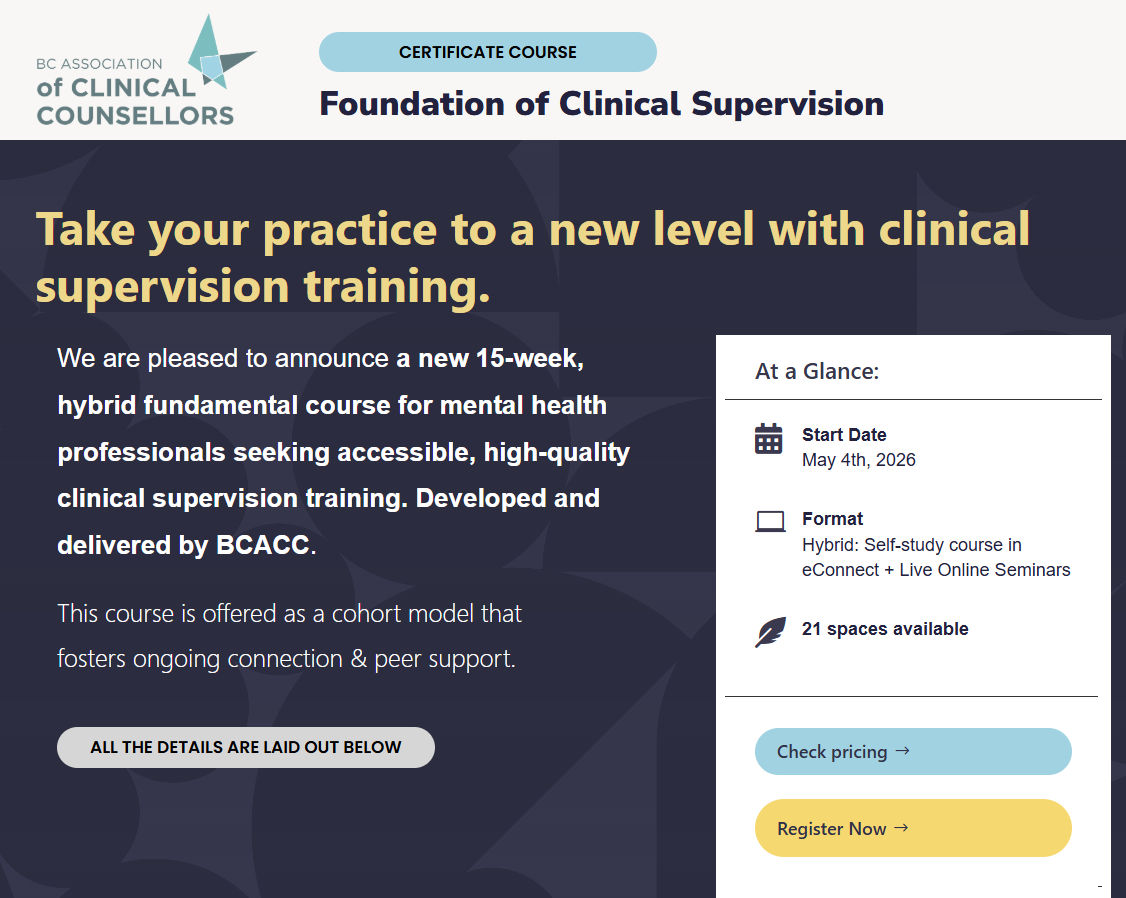
Foundation of Clinical Supervision Course
In September 2025, BCACC launched its first certificate course, Foundations of Clinical Supervision, in response to growing demand for accessible, high-quality supervision training among members and mental health professionals.
Delivered through a cohort-based model, the course fosters peer connection and ongoing professional support and is led by experienced clinical supervision educators. The curriculum emphasizes competency-based learning, with a focus on reflective practice, ethical decision-making, and supporting supervisees from diverse backgrounds.
The course has seen strong demand since its launch, with planned expansion in 2026 to meet increasing demand.
Clinical Supervision Summit
In June 2025, BCACC hosted its Clinical Supervision Summit, bringing together clinical supervisors for a full day of professional learning, reflection, and connection.
The event featured two interactive workshops focused on advancing supervisory practice. The morning session explored decolonizing clinical supervision, engaging participants in critical conversations about culture, power, and relational approaches. The afternoon session introduced fundamentals of Supervision-of-Supervision practice, equipping experienced supervisors with advanced skills to mentor and support the next generation of clinical supervisors.

The Summit provided a valuable opportunity for participants to deepen their competencies, engage in peer learning, and strengthen professional networks, contributing to the ongoing development of high-quality and culturally responsive supervision practices.
Looking Ahead
BCACC remains committed to supporting clinical excellence, strengthening the profession, and ensuring that RCCs are well-positioned to succeed in both the current and future regulatory landscape.