REGULATION & PUBLIC PROTECTION
Our mandate
The BCACC continues to take proactive efforts to enhance its public protection measures.

The BCACC continued to fulfill its mandate to protect the public through the regulation of its registrants.
It did so by:
1. Determining registration requirements and granting authorized use of the Registered Clinical Counsellor (RCC) title;
2. Setting standards of practice;
3. determining education requirements;
4. Maintaining a newly created member register that everyone can search; and
5. Addressing complaints about its registrants.
Registration
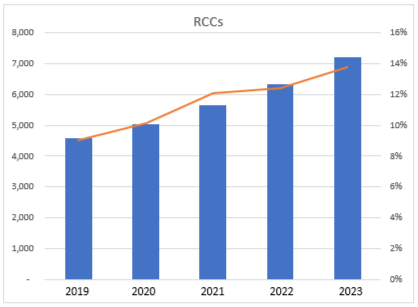
In 2023, the BCACC granted the RCC title to 900 new registrants resulting in an increase in the number of RCCs of 14% year on year. The RCC designation continues to be recognized by more and more employers and institutions and is sought after by mental health professionals.
Complaints/inquiry
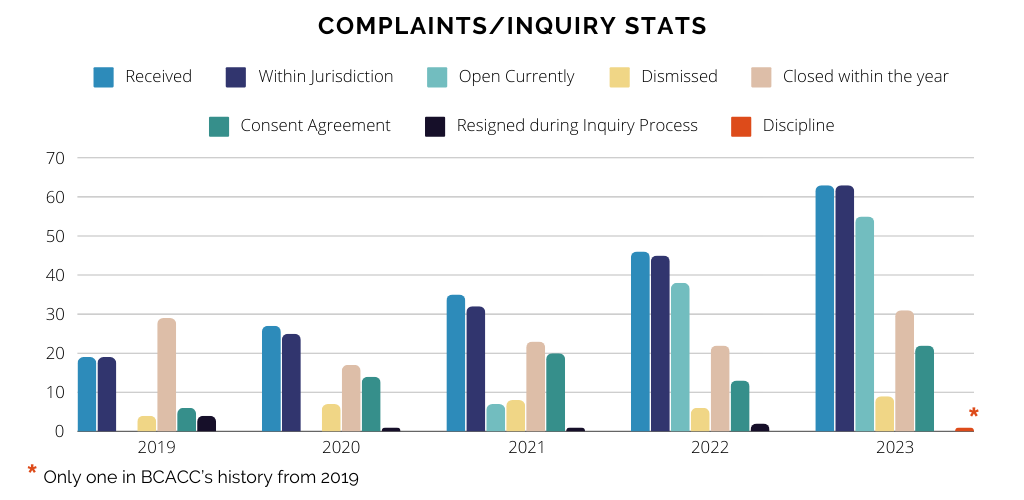
The number of new public complaints received continues to increase year-over-year due primarily to the increase in registrants each year.
Historically almost all complaints are resolved through consent agreements with only one resulting in disciplinary action, and just a few registrants resigning in the middle of an inquiry process. As a percentage of the overall number of registrants, the number of complaints remains in line, if not below, those of other BC Health regulatory colleges at less than 1%.
This is really a testament to the professionalism shown by RCCs as they voluntarily agree to be regulated and be held to account by the BCACC under the Societies Act.
The largest number of complaints received fell into two categories:
1) High conflict family situations
(which the BCACC addressed previously with a new standard and province wide multi-day training workshops);
2) Clinical Supervision
(which the BCACC addressed with a new clinical supervision designation requiring more scrutiny and training).
Regulatory Modernization
The BCACC continues to take proactive efforts to enhance its public protection measures and to prepare itself and its members for the new Health Professions and Occupations Act.
The BCACC consulted with and/or obtained support from multiple stakeholders including the BC Ministry of Health, Provincial and Federal Labour Mobility Ministry Branches and health profession regulatory colleges in BC as well as from across Canada to validate its regulatory building blocks.
Throughout 2023 the BCACC continued to build on and enhance its work through:
- the Clinical Supervision Program,
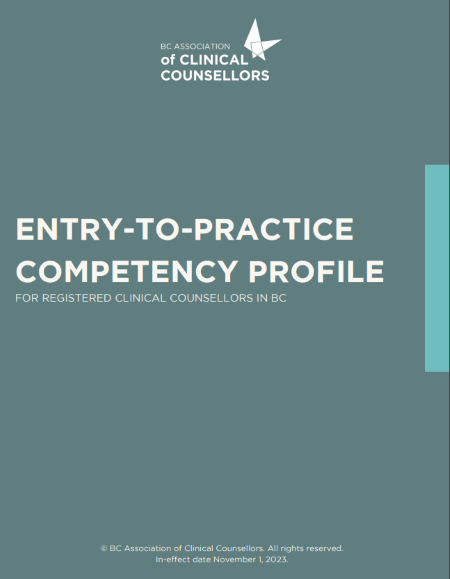
- the Entry to Practice Competency framework,
- a publicly viewable member registry,
- presentation/representation at the Canadian Network of Agencies for Regulation (CNAR) on the topic of the regulation of Clinical Counselling
- and released new/updated standards and code of ethical conduct.